Flatbed freight guide
Rebar and Mesh Securement on Flatbed: The Rules That Matter
Rebar is among the most commonly cited cargo in FMCSA out-of-service orders, not because drivers don’t tiedown but because they tiedown incorrectly. Bundles shift along their length. Individual bars work loose through gaps in standard tiedowns. Wire mesh panels catch wind and can become rigid sails on a flatbed. Getting securement right on these loads is both a regulatory requirement and a safety issue that ends careers.
How FMCSA categorizes bundled steel
The federal cargo securement rules treat rebar, angle iron, bar stock, and structural shapes as “metal coils, bar stock, and similar articles” unless they are wrapped, banded, or unitized in a way that qualifies them as a single article. A loose bundle of 20-foot #6 rebar is not one article — it is a bundle of individual articles, and each one is theoretically capable of sliding or falling independently.
Practically, drivers work with banded bundles, and inspectors evaluate whether the banding is structural enough to treat the bundle as a unit. A single strand of 16-gauge wire around a 2,000-lb rebar bundle is not structural. A steel strap crimped in four places over a bundle that doesn’t flex is closer to what inspectors accept as unitized cargo.
If your banding is marginal, your securement calculation needs to account for bundle-level containment: tiedowns must run over the top of the bundle and apply downward pressure, not just lateral restraint.
Calculate your minimum tiedowns before loading
Use the free load securement calculator to find the minimum tiedowns required under federal rules for your specific cargo weight and length. For rebar, you will typically need to satisfy:
Aggregate WLL rule (49 CFR 393.106): The combined working load limit of all tiedowns must equal at least 50% of the cargo weight. A 40,000-lb load of rebar requires at least 20,000 lbs of combined WLL. If you’re running 3/8” Grade 70 chains at 6,600 lbs WLL each, that’s three chains minimum from the weight rule.
Length rule (49 CFR 393.110): Twenty-foot bundles are well into the “2 tiedowns + 1 per additional 10 feet” territory. A 40-foot stack of rebar bundles requires at minimum 2 + ⌈(40−10)÷10⌉ = 5 tiedowns. Most loads will be governed by the length rule rather than weight.
Dunnage and friction mat placement
Bare rebar on a bare flatbed deck is a low-friction surface. Rebar is round. Without dunnage or friction mat, tiedown tension that appears adequate at the shipper can allow significant cargo movement by the time the truck reaches the highway.
Friction mats (rubber-based materials rated for cargo securement) must be placed between the deck and the bottom layer of rebar. For stacked bundles, friction mat between layers is also advisable. Dunnage — typically 4×4 lumber — can substitute for friction mat and has the added benefit of raising the bundle slightly off the deck, which makes chains easier to seat without point-loading the bundle’s lower edge.
Place dunnage transversely (across the trailer width), not longitudinally, so it distributes weight across deck boards rather than concentrating it at two points.
Choke-point and over-the-top rigging
For rebar that has not been unitized into a rigid bundle, over-the-top tiedowns are mandatory, not optional. A tiedown that simply runs from stake pocket to stake pocket alongside the bundle does not restrain individual bars from sliding out — it only creates a lateral fence.
Over-the-top configuration: the tiedown anchor on one side of the trailer, runs up and over the top of the bundle, and anchors on the opposite side. This applies downward force and friction rather than lateral containment.
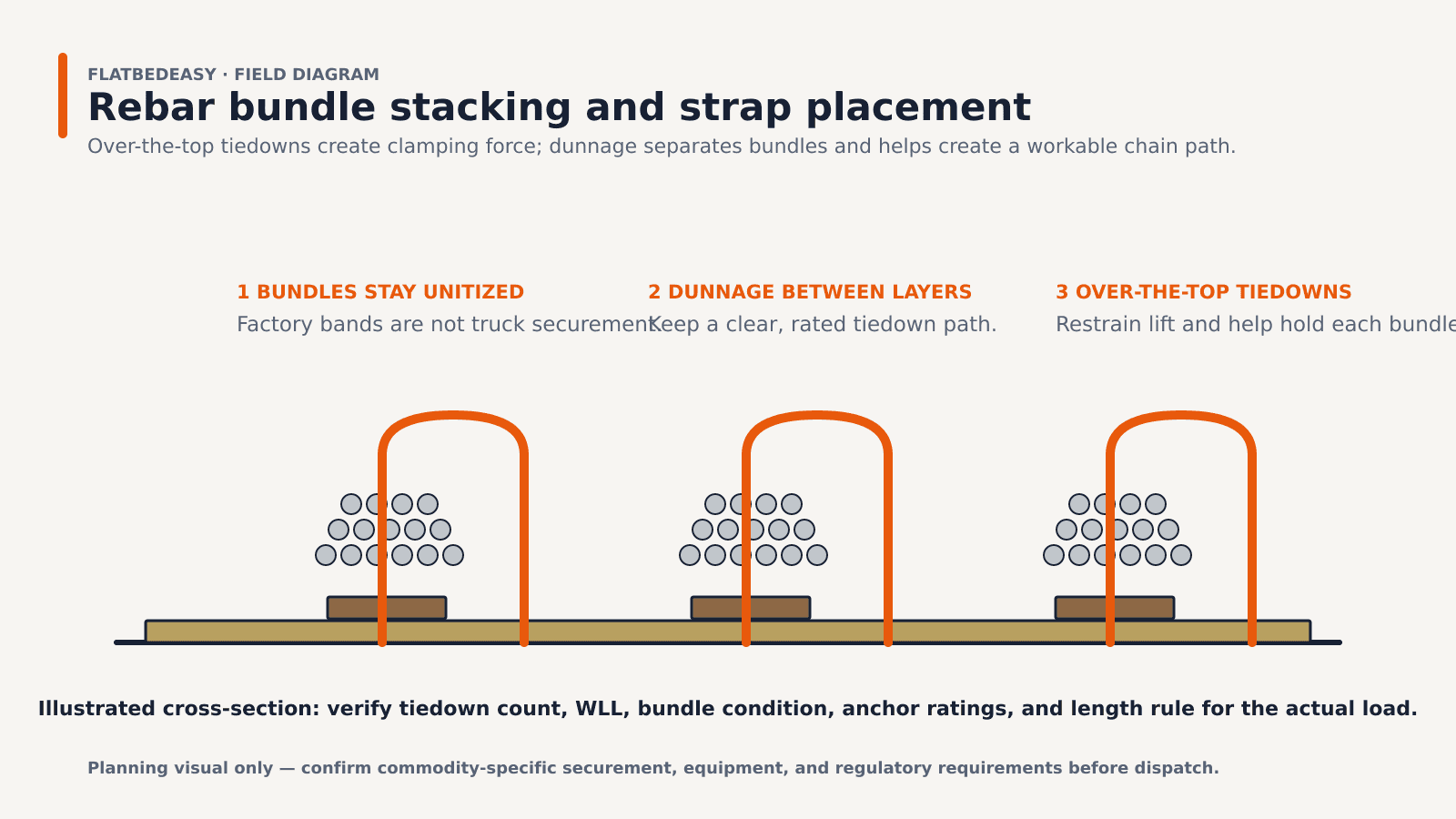
For 40-foot bundles on a 48-foot flatbed, run over-the-top tiedowns at the front, rear, and at least one point near center. Do not rely on the front headboard to substitute for a front tiedown — headboards are not rated as securement devices for steel cargo.
Wire mesh: the wind problem
Wire mesh (welded wire reinforcement, chain-link panels, or expanded metal sheets) presents a different challenge: it is rigid, relatively light per panel, and has substantial wind-catching surface area. At highway speed, unseated mesh panels can generate lift that defeats horizontal tiedown tension.
Stack mesh panels flat on the deck, not upright. If panels must be stacked vertically (height constraints), block them against the front and rear stanchions so there is no path for forward or rearward displacement in a stop event. Cover exposed mesh with a tarp whenever possible — this both reduces wind load and protects panels from debris damage that creates liability on the return leg.
Tiedown placement for flat-stacked mesh should cross the stack diagonally as well as perpendicular. A diagonal cross-tiedown resists the tendency of flat panels to “fan out” when tiedown tension is applied straight across the stack.
Common roadside inspection failures on rebar
FMCSA roadside inspection data consistently shows the following as the most-cited violations on rebar and mesh loads:
Insufficient tiedown count for length. Drivers calculate WLL adequately but fail to count the total cargo length correctly. A flatbed loaded with multiple bundles of different lengths must use the combined load footprint for the length rule.
WLL not verified. Tiedowns with faded or illegible WLL markings are treated as having no rated WLL during inspection. Replace any tiedown where the WLL tag is missing, damaged, or illegible.
Chaining the bundle instead of the cargo. Running a chain through the banding steel of a rebar bundle is not equivalent to running it over the cargo. The banding is not a structural securement point — it can cut or fail under load.
Corner protectors missing. Wire mesh and rebar with sharp edges can cut webbing straps to failure during transport. Any strap-based tiedown over steel with sharp edges must use corner protectors rated for the application. Chains do not require corner protectors.
What to document at shipper pickup
Before you leave the facility, photograph the load from all four corners plus two from overhead (if a ladder is available). Note the bundle count, banding condition, and tiedown count on the BOL. If the shipper’s banding fails to meet structural criteria and you’ve added your own cross-tying, note that too.
Documentation protects you if a bundle is found loose at the receiver and liability is disputed. A time-stamped photo with the shipper’s dock visible in the background establishes the load condition at origin.
Cost of a securement out-of-service order
An OOS order grounds the vehicle until securement is corrected. On a rebar load, that typically means finding an inspection station with room to re-rig, purchasing tiedown equipment if you’re short, and losing two to four hours of drive time at minimum. If the load is time-sensitive — a pour is scheduled — the shipper may have actionable damages. A single OOS citation can also affect the carrier’s safety rating, which affects insurance premiums and broker acceptance for months.
Getting securement right at loading takes 15–20 extra minutes. Use the load securement calculator before the truck is loaded so you know exactly how many tiedowns you need before the first bundle hits the deck.
Ready to move your load?
Post a load — free instant rate
Get an instant rate estimate from vetted flatbed carriers. Dock scheduling and live visibility included. Free to start.
Post a load →Related guides
Flatbed Load Securement Rules: FMCSA Requirements Explained
FMCSA 49 CFR Part 393 securement rules for flatbed loads: WLL math, chain vs strap, tiedown spacing, edge protection, and blocking requirements.
Read guide →Shipping Coils, Steel, and Metals on Flatbed: A Practical Field Guide
How to ship steel coils, plate, beams, and rebar on flatbed. Coil racks, eye-to-side vs eye-to-sky, chain requirements, mill pickup rules, and crane windows.
Read guide →Winter Flatbed Operations: Tarping in Wind and Ice
How flatbed trucking changes in winter. Tarping in wind and ice, ice accumulation on cargo, permit delays, and the securement issues that only appear below freezing.
Read guide →