Flatbed freight guide
Flatbed Tarping: When You Need It, What It Costs, and What to Demand
Tarping is a cargo instruction, a labor item, and a risk-control decision. A law may require cargo to be protected from falling or leaking material, a purchase order may make coverage a condition of acceptance, and a prudent operator may cover a surface that will oxidize or stain. FMCSA does not require a tarp for most ordinary lumber, steel, or machinery simply because it rides on a flatbed. A receiver’s written specification can still make tarping mandatory for the shipment.
Commodity decisions
Lumber should be treated as full-coverage freight. Rain enters bundle gaps and end grain, causing swelling, stain, mold, and moisture-content disputes. Finished, painted, and galvanized steel is normally tarped to limit oxidation and road film. Raw structural steel and as-rolled plate often travel bare if the receiver permits it. Aluminum needs a clean tarp because salt, abrasion, and water spotting can ruin an otherwise sound surface.
Machinery is case-specific: painted cabinets, electrical enclosures, and precision equipment need protection, while raw castings may need only a smoke tarp over the front. Precast concrete is commonly bare. Coils require a steel tarp when the mill or buyer says so, with coverage shaped around the rack rather than allowed to pool in the eye.
| Commodity | Typical requirement | Tarp type | Typical fee |
|---|---|---|---|
| Dimensional lumber | Full coverage | 24 oz lumber, 16-foot drop | $250–$600 |
| Finished steel | Full or top coverage | 18 oz steel, often two | $150–$450 |
| Raw beams/plate | Receiver-dependent | Smoke or steel | $150–$350 |
| Aluminum extrusions | Clean full coverage | Light steel tarp, edge protected | $200–$450 |
| Coated pipe | Full coverage, keep dry | Steel or pipe tarp | $200–$500 |
| Architectural glass | Enclosed or specified cover | Padded, non-abrasive cover | $300–$700 |
| Roofing materials | Full coverage | Lumber tarp, dry delivery | $250–$600 |
| Painted machinery | Usually full | Lumber or steel | $200–$500 |
| Precast concrete | Usually uncovered | Smoke if requested | $100–$250 |
| Steel coil | Mill specification | Coil tarp | $200–$500 |
Architectural glass deserves special handling. A tarp can protect from road spray but can also rub a coating or trap condensation; many glass shippers require an enclosed trailer or a rigid, padded shipping case instead. Coated pipe needs protection at the ends and seams, while roofing rolls and packaged shingles need dry delivery because wet packaging can fail before the product is installed.
Tarp construction
A smoke tarp is a short front cover that blocks tire spray and highway debris; it is not waterproofing. A lumber tarp has a 16-foot or longer drop, typically 24-ounce vinyl, and is placed waterfall-style over sides and ends. Two are often needed on a 40-foot load. Steel tarps generally have approximately 8-foot drops and use 18-ounce vinyl for compact flat loads. Coil tarps have shorter or shaped drops to clear a rack and keep a tiedown from pulling the cover into the eye.
Overlap seams by at least 6 inches; 12 inches is safer where wind reaches the seam. Protect vinyl from banding, board corners, and chain contact. A tarp that is tight but unsupported over a sharp load can tear before the first fuel stop.
Installation sequence at pickup
The driver should inspect the folded tarp, grommets, D-rings, straps, and corners before climbing onto the deck. Do not install over loose debris or a protruding chain. First secure the freight, install edge protection, and confirm that the tarp will not cover lights, license plates, conspicuity tape, or the trailer’s required markings.
- Fold the front tarp so its leading edge is manageable, then position it at the front of the commodity. The front tarp goes down first because it sheds wind and water toward the rear.
- Drape the tarp evenly over the load, allowing both side drops to hang below the top edge. Do not pull a corner across an exposed steel edge; use a board, rubber protector, or folded tarp pad at each contact.
- Work down each side and attach to trailer D-rings approximately every 18 inches, keeping the tension balanced left to right. The strap should pull the cover down, not inward across a sharp product corner.
- Walk the top and sides before adding tension. Smooth folds that could hold water, keep grommets aligned, and leave enough slack for the tarp to flex without tearing. Secure loose rear and front flaps rather than tying them to a suspension or light bracket.
- Place the rear tarp after the front tarp is tight. Drape it over the remaining load and overlap the front tarp by at least 12 inches. The rear edge should shed water over the seam, not under it.
- Attach the rear cover to every available D-ring at approximately 18-inch intervals, check the opposite side, and finish with a walk-around. There should be no loose flap near tires, exhaust, chains, or landing gear.
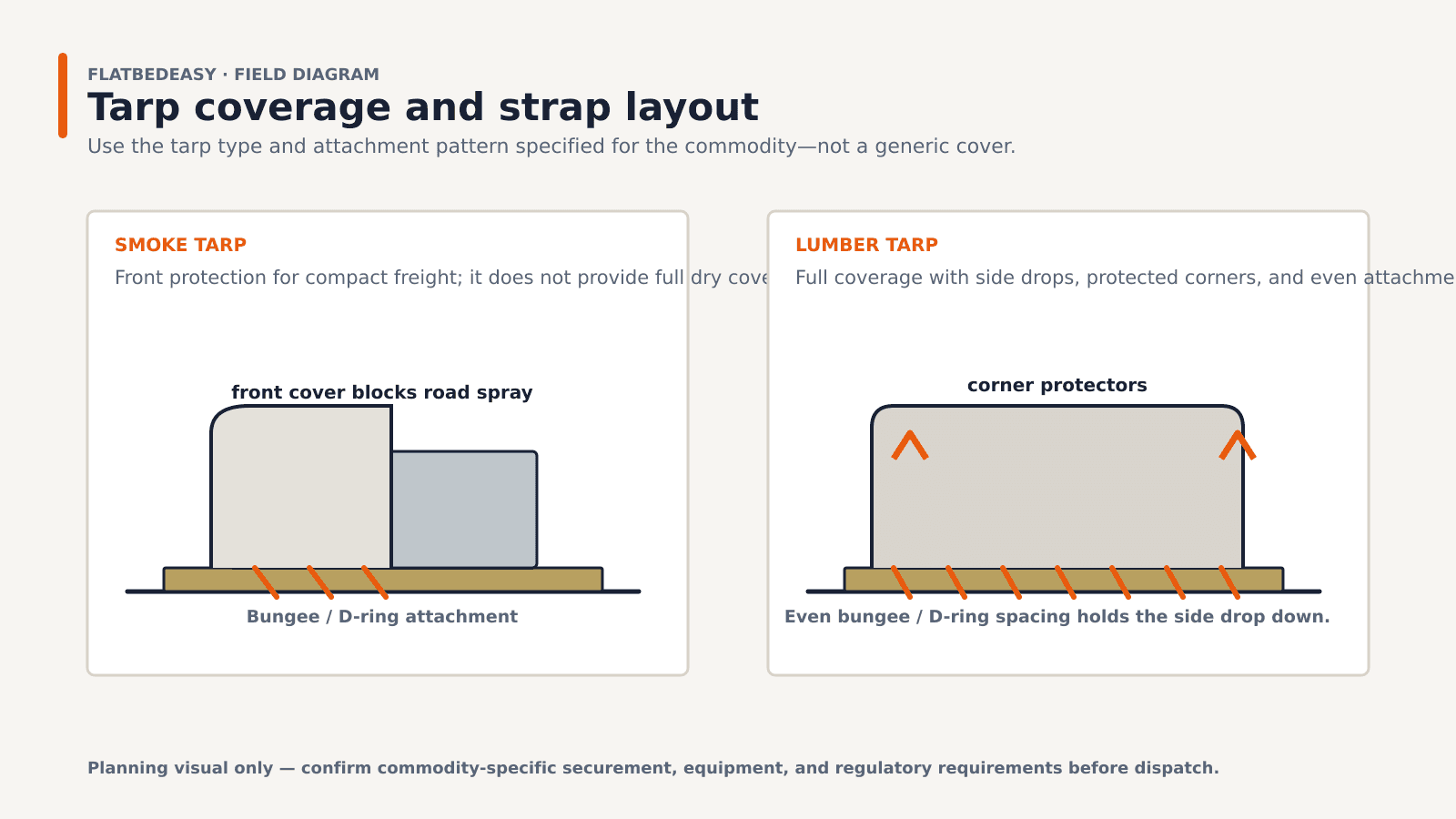
The driver should photograph the completed cover and record any shipper-provided tarp or damaged grommet before departure. Recheck after the first 50 miles, after a major weather event, and whenever a strap has stretched or shifted.
Driver and shipper responsibility
FMCSA 49 CFR 393.100 places ultimate responsibility for preventing cargo movement and falling material on the motor carrier and driver. The driver decides whether a cover is safe, whether the tiedowns remain accessible, and whether the load can legally depart. A shipper cannot waive that duty with a signed instruction. A carrier also cannot promise “full protection” and then send a truck with no suitable tarp.
The shipper should state the commodity, coverage standard, tarp weight, surface restrictions, and receiver acceptance rule. The carrier should supply serviceable equipment unless the rate confirmation specifically says the shipper will furnish a clean, rated tarp. If a shipper supplies a tarp that is torn, too short, or contaminated, the driver should document the defect and request a replacement before leaving. Tarp labor, rental, washing, and replacement responsibility belong in the confirmation rather than an assumption.
Write the requirement and price
Standard single-tarp charges run $150–$450. Lumber requiring several heavy tarps commonly reaches $250–$600. Wide freight, custom coverage, wet tarps, and difficult rigging can exceed those ranges. Put “two 24 oz lumber tarps, $450” on the rate confirmation. Tarp labor is not automatically included in linehaul.
The BOL should say “Full tarp coverage required—24 oz lumber tarp minimum; maintain dry delivery,” not “tarp if needed.” Also state whether the receiver rejects torn, wet, or improperly overlapped covers. Vague wording produces a predictable claim dispute: the shipper says the truck promised waterproofing while the carrier says only a smoke tarp was requested. A separate tarp line also allows a broker to compare quotes honestly.
What failure looks like at highway speed
A 24-ounce vinyl tarp is heavy on the dock but becomes a large aerodynamic panel at 65 mph. If a side drop is loose, air can enter underneath, creating lift and repeated load cycles at the grommets. The cover can balloon, pull a D-ring loose, tear along a seam, or strip a strap. A one-inch gap at the leading edge can feed a surprisingly large volume of air under the cover; the result is not corrected by simply tying the loose corner to a stake.
When a tarp comes off, the immediate hazard is flying debris. Vinyl can cover a following driver’s windshield, wrap an axle, or cross multiple lanes. The carrier may face citations, an injury claim, cargo damage, cleanup expense, and a claim for the delay. Courts generally focus on foreseeability and control: a motor carrier that knew or should have known that cargo or a cover was unsecured cannot shift all responsibility to a shipper’s vague instruction. A shipper’s defective packaging or unsafe loading can contribute to fault, but a driver’s pre-trip inspection, continuing inspection, and decision to operate remain important evidence.
The practical response is to pull over safely, warn traffic if possible, and never continue with a flapping cover. Photograph the failure, preserve the tarp and straps, notify dispatch and the cargo owner, and record weather and road conditions. Do not discard torn material before the claim investigator has inspected it.
Pickup inspection and scheduling
Dock scheduling should capture the tarp specification. A Dock Optimizer workflow can flag “two lumber tarps” during appointment booking, reserve the right trailer, and require a pickup photo showing overlap and D-ring attachment. That prevents a smoke-tarp truck from arriving at a receiver that demands full coverage. See /guides/flatbed-load-securement-rules for the securement beneath the cover and /guides/how-flatbed-rates-are-built for fee language.
Weather forecasts should inform dispatch but never replace a written requirement. Keep spare edge protectors and replacement straps available, because a tarp can remain intact while its tie-down hardware fails after repeated wind loading. Inspect at pickup, after the first 50 miles, and whenever the driver stops to adjust securement.
Ready to move your load?
Post a load — free instant rate
Get an instant rate estimate from vetted flatbed carriers. Dock scheduling and live visibility included. Free to start.
Post a load →Related guides
Flatbed Load Securement Rules: FMCSA Requirements Explained
FMCSA 49 CFR Part 393 securement rules for flatbed loads: WLL math, chain vs strap, tiedown spacing, edge protection, and blocking requirements.
Read guide →Lumber and Building Materials on Flatbed: Tarping, Banding, and Jobsite Delivery
How to ship lumber, OSB, wall panels, and trusses on flatbed. Tarp requirements, banding specs, moisture damage prevention, and jobsite delivery without a dock.
Read guide →How Flatbed Rates Are Built: Linehaul, Fuel, Tarp, and Oversize
Anatomy of a flatbed freight rate: linehaul, DOE fuel surcharge, tarp fee, OD permits, layover, and detention. Learn what's negotiable and what isn't.
Read guide →