Flatbed freight guide
Flatbed Load Securement Rules: FMCSA Requirements Explained
49 CFR Part 393, Subpart I is the operating rulebook for commercial cargo securement. It requires a system that prevents shifting and falling during acceleration, braking, cornering, vibration, and ordinary road shock. The rule applies even when the shipper has banded the freight. The driver owns the final inspection, but the shipper supplies the facts that make a safe plan possible: accurate weight, center of gravity, blocking points, and equipment instructions.
Working load limit math
The aggregate working load limit (WLL) of tiedowns must equal at least 50% of cargo weight. A 40,000-pound load therefore needs 20,000 pounds of combined WLL. Five 5/16-inch Grade 70 chains rated at 4,700 pounds each provide 23,500 pounds and meet that basic calculation. This is not permission to place five chains randomly: chain angle, anchor points, binders, blocking, and commodity geometry must also restrain movement.
| Cargo | 50% WLL target | Example plan | Aggregate WLL |
|---|---|---|---|
| 5,000 lb | 2,500 lb | 2 × 2-inch straps at 3,333 lb | 6,666 lb |
| 15,000 lb | 7,500 lb | 4 × 5/16-inch G70 chains | 18,800 lb |
| 30,000 lb | 15,000 lb | 4 × 3/8-inch G70 chains | 26,400 lb |
| 45,000 lb | 22,500 lb | 5 × 3/8-inch G70 chains | 33,000 lb |
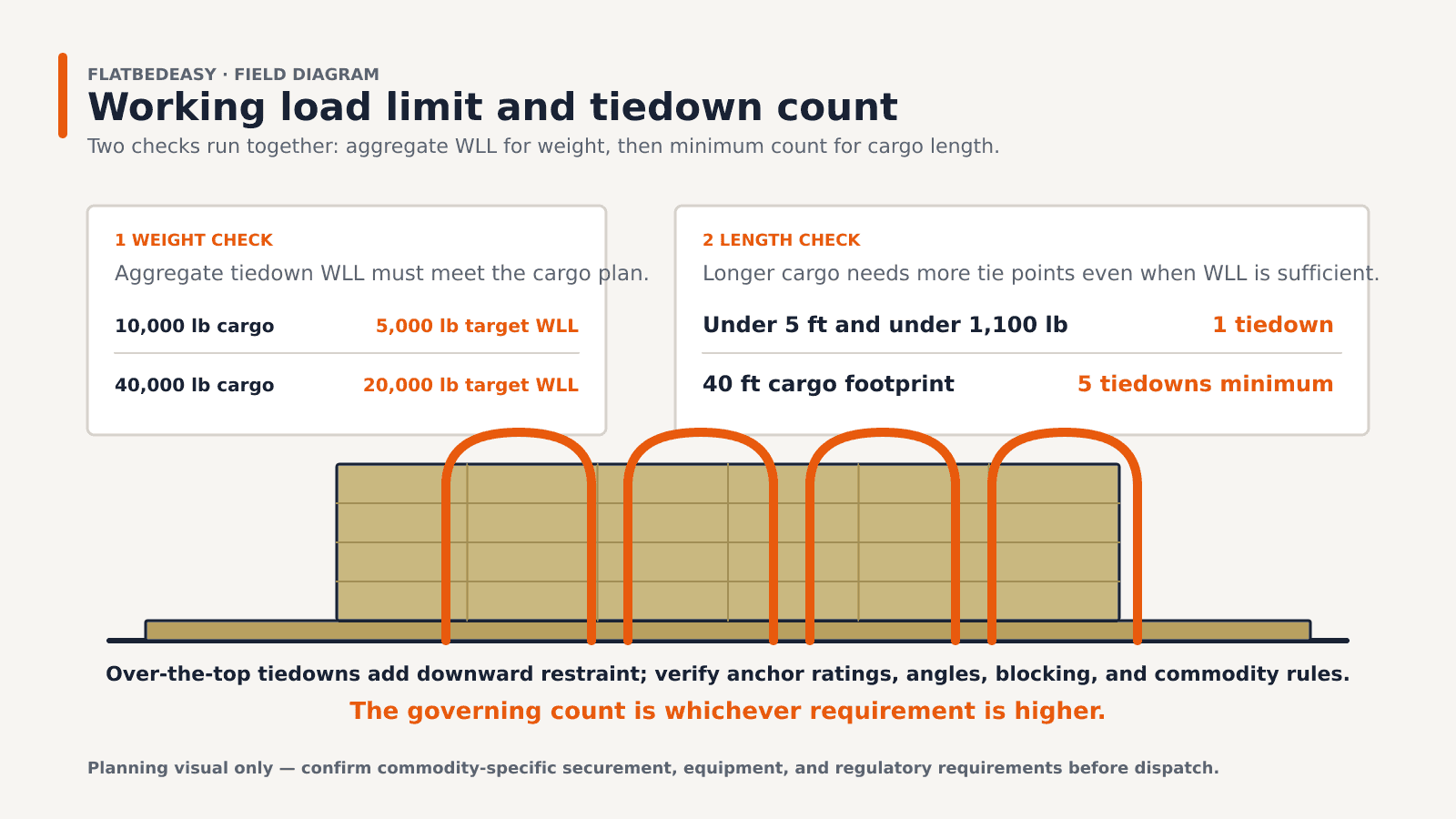
Use stamped ratings, not memory. The weakest component—hook, binder, anchor, strap, chain, or blocking—limits the system. A high-rated chain attached to a low-rated stake pocket does not create a high-rated tiedown.
Chain, webbing, and edge protection
Grade 70 transport chain is common for steel and machinery. A 3/8-inch Grade 70 chain has a 6,600-pound WLL; 1/2-inch Grade 70 is 11,300 pounds. Grade 43 high-test chain is lower capacity and is acceptable only when its marked WLL satisfies the plan. Grade 80 alloy chain is selected for heavy equipment, but hooks and binders must match.
| Chain grade | Size | Typical WLL | Application |
|---|---|---|---|
| Grade 43 | 3/8 in | about 3,900 lb | General cargo when sufficient |
| Grade 70 | 5/16 in | 4,700 lb | Transport machinery and steel |
| Grade 70 | 3/8 in | 6,600 lb | Coils and heavy equipment |
| Grade 70 | 1/2 in | 11,300 lb | High-weight systems |
| Grade 80 | 3/8 in | about 7,100 lb | Alloy chain, marked rating required |
Two-inch webbing straps commonly carry a 3,333-pound WLL. Use them for lumber and painted surfaces when edges are protected. Raw steel, coils, loose pipe, and sharp corners can cut webbing; use chains or a documented edge-protected alternative.
Edge protection is required when a tiedown could be damaged by a corner or could damage cargo. Rubber protectors suit cartons, wood dunnage spreads force over rough lumber, and metal corner protectors suit plate. Protect every point of contact, not just the visible top edge.
Binders and applied tension
Ratchet binders provide incremental tension and are easier to control in a crowded load. Lever binders are faster but store substantial energy in the handle and chain. A driver should select a binder whose WLL is compatible with the chain, inspect the hooks and pivot, and place the handle where vibration cannot open it or strike a person.
To set tension, lay the chain path correctly, remove slack by hand, engage the binder gradually, and stop when the chain is firm and the load is seated. Use a cheater pipe only if the manufacturer permits it; a longer handle can exceed the binder or chain rating. Secure a ratchet handle against movement and lock a lever binder according to its design. Never stand in the line of a lever handle or between the chain and cargo.
Over-tightening does not make a load safer. Excess tension can deform a crate, crush a lumber bundle, overload an anchor, or stretch chain links past their intended working range. Repeated overload can cause crystalline fatigue and microscopic cracking in chain metal; a link may fail later under braking even when it looks acceptable. Lever binders can snap back violently when released, which is why some shippers ban them around steel coils, narrow walkways, or pedestrian loading areas. If a shipper bans lever binders, use rated ratchets or another approved system and write that requirement into dispatch instructions.
Count, spacing, blocking, and bracing
One tiedown is allowed for cargo under 5 feet long and under 1,100 pounds. Anything over 5 feet or 1,100 pounds needs at least two. Cargo longer than 10 feet needs one additional tiedown for each additional 10-foot increment. A 30-foot steel beam therefore needs at least four by count: two for its size, plus one for each of the two additional 10-foot increments. Weight and direction may require more.
Securement must address forward, rearward, lateral, and upward movement. Forward braking is the critical case: plan to restrain 80% of cargo weight toward the front. A 20,000-pound crate needs 16,000 pounds of forward resistance. A positive front stop plus angled tiedowns can achieve this; a loose piece of two-by-four cannot.
Blocking material must be sound hardwood lumber, commonly at least 4x4 inches where the design calls for a substantial stop. Use no softwood that crushes under load, no composite scrap, and no pallets as primary blocking. Pallets can collapse or split and may serve only as packaging or leveling material when the securement plan independently prevents movement.
For cylindrical pipe sections, use shaped hardwood chocks on both sides of each section or bundle, with separators between layers and chains positioned to prevent rolling. Chocks must contact the radius and be fastened or captured so they cannot shoot out during braking. For a rectangular machinery crate, place blocking against structural frame members, not thin sheathing; use front stops, rear stops where required, and dunnage that spreads pressure without crushing the crate. For irregular farm equipment, lower or pin moving parts, identify the center of gravity, block wheels or tracks, and brace projecting arms independently. Do not rely on a single chain across a bucket, boom, or attachment that can pivot.
FMCSA roadside inspection
During a Level I North American Standard inspection, the officer examines the driver, vehicle, and cargo. The cargo portion includes the load’s distribution, tiedown count, WLL markings, chain and strap condition, anchor points, edge protection, blocking, and evidence that cargo can shift or fall. The officer may ask the driver to explain the commodity, inspect a hidden chain path, or require a cover to be opened so securement can be seen. A tarp is not a substitute for inspection.
An unsecured load that can shift or fall can result in an out-of-service order: the vehicle cannot continue until the condition is corrected. A missing WLL marking, a damaged tiedown, or an inadequate capacity calculation may produce a citation or violation; if the deficiency creates an immediate serious hazard, the outcome can also be OOS. Exact treatment depends on the observed condition and enforcement guidance, so carriers should not plan around the least severe interpretation.
Violations are recorded in the carrier’s roadside inspection history and can affect the FMCSA Safety Measurement System (SMS), including the cargo-related BASIC. A single event is not a mathematical guarantee of a particular score, but repeated cargo violations increase intervention risk, insurance scrutiny, and shipper concern. Corrective action means replacing equipment, retraining drivers, documenting the repair, and fixing the loading process—not merely paying a citation.
Final inspection practice
An officer looks for unreadable WLL markings, damaged webbing, bent hooks, loose binders, broken factory bands mistaken for truck securement, inadequate count, poor edge protection, and cargo that can roll. The driver should photograph the loaded condition, inspect within the first 50 miles, and readjust after vibration settles dunnage.
The carrier should record weight, tiedown count, anchor locations, blocking, and any shipper-directed exception. Do not pressure a driver to leave with a damaged chain or an axle overload. Coil examples are at /guides/coil-steel-metals-flatbed, and tarp interaction is covered at /guides/flatbed-tarping-guide. Factory packaging holds a bundle together; only the complete truck securement system keeps it on the trailer.
Ready to move your load?
Post a load — free instant rate
Get an instant rate estimate from vetted flatbed carriers. Dock scheduling and live visibility included. Free to start.
Post a load →Related guides
Flatbed vs Step Deck vs RGN: Choosing the Right Open-Deck Trailer
Compare flatbed, step deck, and RGN trailers by height, weight, and freight type. Includes permit thresholds and a cost-premium guide.
Read guide →Flatbed Tarping: When You Need It, What It Costs, and What to Demand
When is a tarp required on a flatbed? Lumber vs steel tarps, tarp fee ranges ($150–$450+), what to put on your BOL, and how to avoid freight claims.
Read guide →Shipping Coils, Steel, and Metals on Flatbed: A Practical Field Guide
How to ship steel coils, plate, beams, and rebar on flatbed. Coil racks, eye-to-side vs eye-to-sky, chain requirements, mill pickup rules, and crane windows.
Read guide →