Flatbed freight guide
Shipping Coils, Steel, and Metals on Flatbed: A Practical Field Guide
Steel freight is not one commodity operationally. Hot-rolled coil, cold-rolled coil, galvanized coil, cut-to-length plate, as-rolled plate, wide-flange beam, H-pile, rebar, angle, tube, and pipe have different centers of gravity, surface risks, and loading equipment. Send the carrier the mill weight, outside dimensions, number of pieces, orientation, rack requirement, and tarp rule before dispatch.
Coil products change the shipping plan
Hot-rolled coil is formed at high temperature and normally has a less delicate mill scale surface. It is more tolerant of ordinary handling, but its exposed steel edges can cut webbing and it still needs positive restraint. Treat hot-rolled coil as chain freight: a 3/8-inch Grade 70 chain has a 6,600-pound WLL, and four chains provide 26,400 pounds when the rack and anchors are adequate.
Cold-rolled coil has a smoother, more finished surface and is often shipped for stamping, automotive, or appliance work. Protect the edge and face from chain contact, rack burrs, and dirt. Use rated edge protectors wherever a tiedown bears near the slit edge; a scratch that seems cosmetic at pickup can become a rejection when the customer runs the coil through a finishing line.
Galvanized coil is surface-sensitive and especially vulnerable to water staining, white rust, and abrasion of the zinc coating. The mill or buyer commonly requires full tarping, clean dunnage, and protected chain paths. A tarp must fit the rack without rubbing the coating or trapping water in the eye. Keep wet, dirty, or oil-contaminated covers away from galvanized faces.
Hot-rolled coils commonly weigh 15,000–50,000 pounds, with many production coils between 40,000 and 48,000. Cold-rolled and galvanized coils may be lighter, but their claims can be more expensive. A 48-foot flatbed with approximately 48,000 pounds of legal payload can often carry one large coil. Two coils of 20,000–25,000 pounds each may fit only after including the tractor, trailer, rack, dunnage, chains, and axle limits.
Orientation and rack selection
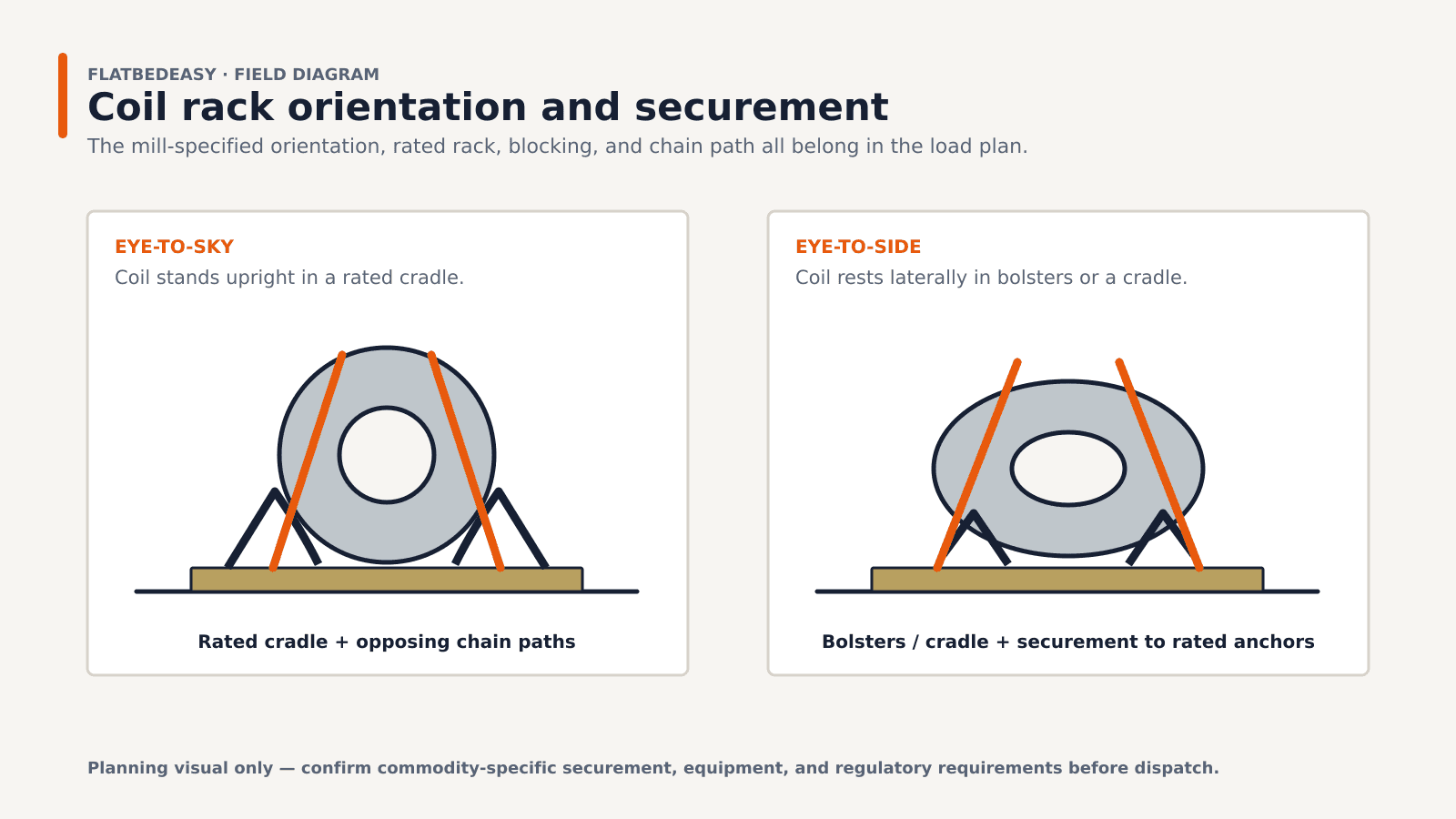
Eye-to-side means the coil lies on its side with its axle horizontal across the trailer. It normally sits in bolsters or a cradle and is stable when the rack is rated, blocked, and centered. Eye-to-sky means the coil stands upright with its axle vertical. It requires a cradle that supports the curved surface and prevents rolling. Mills choose orientation based on crane hooks, processing lines, and customer specification; a driver cannot change it casually at pickup.
| Steel product | Typical weight | Coil rack needed? | Tarp? | Key securement |
|---|---|---|---|---|
| Hot-rolled coil | 15,000–50,000 lb | By orientation | Receiver-specific | G70 chain, blocking |
| Cold-rolled coil | 15,000–45,000 lb | By orientation | Usually clean full cover | Protected chain paths |
| Galvanized coil | 15,000–45,000 lb | If eye-to-sky | Usually full | Dry tarp, edge protection |
| Cut plate | 5,000–40,000 lb/package | No | Often bare | Chains, corners, dunnage |
| Wide-flange beams | 2,000–12,000 lb/beam | No | Usually bare | Chains, anti-roll separators |
| Rebar bundle | 2,000–10,000 lb | No | Usually no | Chains, wood between layers |
| Tube and pipe lot | 1,000–30,000 lb | No | Receiver-specific | Chocks, chains, guards |
A coil rack is a curved cradle that raises the coil off the deck and supports its radius. Carrier-furnished racks may weigh 800–2,000 pounds, which counts against payload. Ask whether the rack is on the truck, its rated capacity, its width, and whether it fits the mill crane’s arrangement. A shipper-furnished rack still needs an inspection and rating; familiarity is not a securement calculation.
Crane loading at the mill
Crane loading is a controlled sequence, not a truck driver standing under a suspended coil. First, the driver checks in with the shipping desk, confirms the coil tag and orientation, and positions the trailer in the marked loading bay. The driver sets brakes, exits the fall zone, and tells the crane crew whether the rack is carrier-furnished or mill-furnished. The rack is placed on the deck before the lift, with its curved seats aligned to the crane’s intended landing point. Blocking, chocks, and dunnage remain accessible.
The crane operator attaches the approved coil hooks, C-hook, or lifting beam to the mill’s specified lifting points. The operator takes slack slowly and raises the coil a few inches while the crew watches the sling or hook engagement. The driver does not guide the coil by hand. A spotter communicates through the mill’s approved signals or radio and keeps everyone clear of the swing radius.
As the crane slews over the trailer, the driver or spotter verifies that the rack is square with the coil and that the axle will land in the cradle rather than on a rail or loose dunnage. The operator lowers slowly until the curved surface contacts both rack seats. The crane remains loaded while the crew checks that the coil is centered, the rack has not shifted, and no edge is bearing on steel.
The rocking check is the release test. With the coil seated, the operator holds minimal controlled tension while the spotter observes as the crane makes a small, deliberate settling movement. The coil should sit fully in both seats without rolling, lifting one side, or walking the rack. The crew checks the coil ends, rack pins, blocking, and trailer deck. Only after the spotter calls the seat secure does the operator slack the hook and remove the lifting gear. Never release a coil that is resting on one corner, touching a stake, or relying on a loose board to stop movement.
After release, the driver installs the required chains and binders, protects finished surfaces, checks rack locks, and photographs the coil tag. The crane window is not complete until securement and axle weights are verified. The carrier should retain the signed scale ticket and the mill’s coil identification with the BOL. Those records connect the actual piece to the correct customer specification when a truck carries similar coils on different days.
Multi-coil loads and axle weights
The familiar 80,000-pound gross limit is also an axle problem: plan around approximately 12,000 pounds on the steer axle, 34,000 on the tandem drives, and 34,000 on the tandem trailer axles, subject to state, bridge-formula, tire, and equipment rules. A truck can be under 80,000 gross and still be overweight on one group.
With two coils, do not place both centers directly behind the tractor or both over the rear suspension. A forward coil adds weight to the steer and drive groups; moving it rearward transfers weight away from the steer and toward the drives and trailer. A coil near the trailer center tends to load the trailer tandem, while a coil too far forward can make the steer axle heavy and reduce traction. The rack, dunnage, and coil diameter also change the center of gravity.
Obtain individual coil weights and a trailer axle diagram before loading. Weigh after the first coil is seated, then again after the second, rather than assuming symmetrical pieces create symmetrical axle loads. A 22,000-pound and a 25,000-pound coil are not interchangeable if their rack positions differ. Keep enough deck clearance between racks for chains and never move a loaded coil with a pry bar or improvised blocking.
Mill appointments and other products
Steel mills and service centers commonly schedule crane windows, often 6 a.m. to 6 p.m. weekdays with specific slots. Call the traffic desk 24–48 hours ahead and confirm BOL number, weight, dimensions, orientation, rack, tarp, and driver identification. A truck without a rated cradle for a 48,000-pound eye-to-sky coil may be turned away. Rebar bundles are frequently 20 or 40 feet long and 2,000–10,000 pounds each; use wood dunnage between layers, chocks against rolling, and chains with binders. Factory bands hold a bundle together but are not truck securement. Wide-flange beams, angle, and pipe also need separators and positive restraint.
Galvanized, painted, and coated steel generally needs a tarp to prevent oxidation, salt film, and water spotting. Raw beams and plate may ship uncovered if the receiver says so. Tarp overlap and fee language are covered at /guides/flatbed-tarping-guide.
Delivery defects and claims
At delivery, stop the process before the receiver removes all evidence. Photograph rust with a scale or ruler, capture scratches from several angles, and photograph coating damage with the mill tag and coil number visible. Record whether the damage is on the outer wrap, an edge, or a face, and note rain, standing water, tarp condition, rack marks, and any exception on the delivery receipt. Do not let a receiver write only “steel damaged”; request a specific description and quantity.
Notify the carrier, broker, shipper, and cargo insurer promptly. Preserve torn tarp sections, edge protectors, dunnage, and damaged packaging. The claim investigator will compare pickup photographs, mill inspection records, weather, chain paths, and delivery photographs to determine whether rust or a scratch existed before loading, arose in transit, or occurred during unloading. The securement standards in /guides/flatbed-load-securement-rules are useful when reconstructing that chain of custody.
Ready to move your load?
Post a load — free instant rate
Get an instant rate estimate from vetted flatbed carriers. Dock scheduling and live visibility included. Free to start.
Post a load →Related guides
Flatbed Load Securement Rules: FMCSA Requirements Explained
FMCSA 49 CFR Part 393 securement rules for flatbed loads: WLL math, chain vs strap, tiedown spacing, edge protection, and blocking requirements.
Read guide →Flatbed Tarping: When You Need It, What It Costs, and What to Demand
When is a tarp required on a flatbed? Lumber vs steel tarps, tarp fee ranges ($150–$450+), what to put on your BOL, and how to avoid freight claims.
Read guide →Dock Scheduling and Why Flatbed Shippers Wait Longest
Why flatbed loads have 2–5× the detention of van freight. Crane windows, coil rack setup time, seasonal bottlenecks, and scheduling controls.
Read guide →