Flatbed freight guide
Flatbed vs Step Deck vs RGN: Choosing the Right Open-Deck Trailer
Trailer selection starts with a tape measure. Give the carrier packed height, packed width, footprint, weight, center of gravity, loading method, and destination states. A 22,000-pound machine can be an ordinary flatbed shipment or a permitted move depending on the distance from the pavement to its highest point.
What each trailer does
A 48-foot flatbed is the general-purpose trailer for steel, lumber, pipe, building products, and machinery that can sit on a deck about 60 inches above the road. A 53-foot flatbed provides additional length for bundled material, although its approximately 36,500-pound tare can reduce payload. Both load from the side or overhead.
A step deck has a main deck around 52 inches high and a lower deck around 34 inches. The drop keeps tall machinery below the legal height line while leaving the tractor and rear suspension at conventional height. It is common for presses, excavators, crates, wall panels, and equipment with a tall cabinet.
A double-drop has a well approximately 18–20 inches above the road. An RGN, or removable gooseneck, detaches at the front and supplies ramps so tracked equipment can drive on. Use it when a machine will not clear on a step deck, must be driven on, or needs a low center of gravity. Well length and ramp capacity must match the machine.
Height is the trigger
The federal no-permit height convention is 13 feet 6 inches, subject to state route restrictions. Measure from the pavement to the load top, including skids, dunnage, exhausts, and accessories.
| Trailer type | Deck height from road | Approximate load height before 13’6” | Common freight | Cost vs flatbed |
|---|---|---|---|---|
| 48/53-foot flatbed | 60 in | 8’6” | Lumber, steel, pipe | Baseline |
| Step-deck main | 52 in | 9’2” | Tall crates, machinery | 15–25% higher |
| Step-deck lower | 34 in | 10’8” | Presses, equipment | 15–25% higher |
| Double-drop/RGN well | 18–20 in | 11’10”–12’0” | Heavy equipment | 40–80% higher |
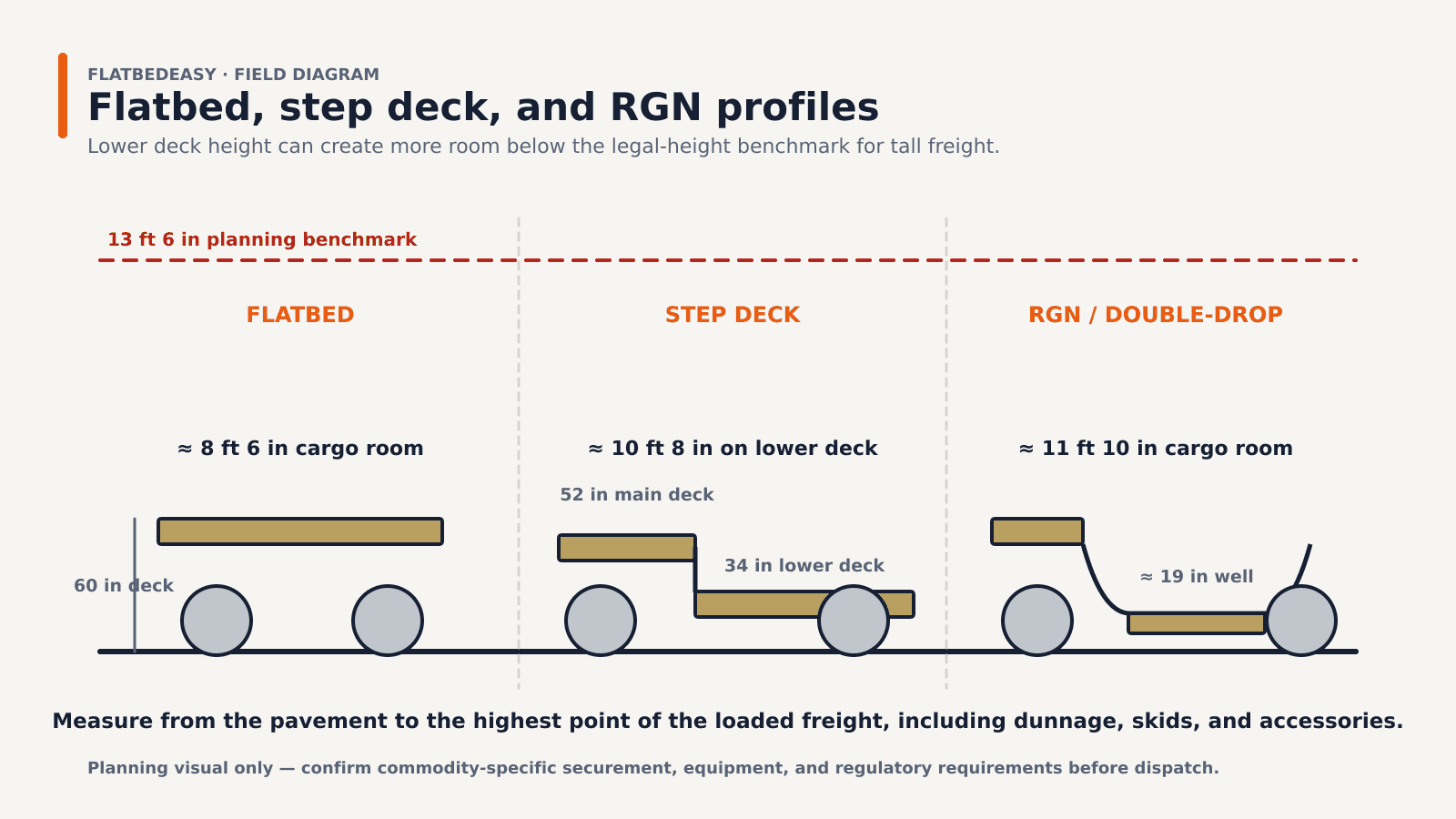
For example, a 9-foot crate on a 60-inch flatbed reaches 14 feet from pavement and needs a height review. The same crate on a 34-inch lower deck reaches 13 feet 10 inches, still slightly over the benchmark. On an RGN well it reaches about 12 feet 6 inches. Tire size, deck camber, blocking, and the state’s measuring practice can consume an apparent margin.
Permits do not make every route interchangeable. A single-state permit covers that state’s roads; a multistate trip requires authorization from each jurisdiction on the route. Applications can specify route, travel hours, axle spacing, dimensions, and escorts. Pilot-car rules vary, but widths over 12 feet and heights over 14 feet 6 inches commonly trigger route review or escort requirements. A superload is often treated as over 150,000 pounds gross or over 16 feet wide, though thresholds differ by state.
Weight and payload
The federal gross vehicle weight ceiling is 80,000 pounds on qualifying Interstate operations, subject to axle and bridge-formula limits. Gross includes tractor, trailer, fuel, chains, racks, dunnage, and cargo. Typical tares are about 35,000 pounds for a 48-foot flatbed, 36,500 for a 53-foot flatbed, 34,000 for a step deck, and 26,000–28,000 for an RGN.
That implies theoretical payloads of 45,000, 43,500, 46,000, and 52,000–54,000 pounds before axle placement reduces the usable number. A lighter RGN is not a free pass: a machine’s center of gravity can overload a tandem axle while gross remains below 80,000. Obtain weight distribution for cargo near 40,000 pounds and request an axle diagram.
Securement still follows 49 CFR Part 393. The tiedown calculation and inspection practices are covered in /guides/flatbed-load-securement-rules.
Worked example: 9’8” CNC machine
Assume a CNC machine is 9 feet 8 inches tall and 22,000 pounds including its skid. On a 60-inch flatbed, road-to-top height is 5’0” + 9’8” = 14’8”. That is 14 inches above the federal benchmark, before extra dunnage. The move needs a height permit, route check, and potentially an escort.
On a 34-inch step-deck lower deck, the calculation is 2’10” + 9’8” = 12’6”. It clears with about one foot of planning margin. A 15–25% step-deck premium may be cheaper than permits, utility-route coordination, and delay exposure. An RGN also clears, but its 40–80% premium is justified only if the machine needs ramps, the low well, or severe-clearance routing. For machine loading details, compare /guides/machinery-flatbed-lowboy.
What the premium buys
Step decks are less numerous, require more careful loading around the transition, and frequently reposition empty, so a 15–25% premium is normal. Double-drops and RGNs add detachable gooseneck hardware, ramps, well-length limits, specialized securement, and often permits; 40–80% above flatbed is common. Compare the premium against permit, escort, survey, and delay costs rather than against linehaul alone. The rate structure is explained at /guides/how-flatbed-rates-are-built.
Before tendering, send the carrier the tallest packed dimension, total weight, footprint, loading equipment, pickup hours, delivery route, and tarp requirement. The correct trailer is the one that keeps the load inside dimensional and axle limits with documented assumptions—not the one with the lowest first quote.
Also identify whether the machine can be tilted, whether doors or guards are removable, and whether the shipper can load from both sides. Those details affect the usable deck, the permit drawing, and the time needed to secure the load. A carrier should not discover at the gate that the only crane has a 12-foot reach or that the crate cannot pass between the step-deck transition and a fixed machine base.
Ready to move your load?
Post a load — free instant rate
Get an instant rate estimate from vetted flatbed carriers. Dock scheduling and live visibility included. Free to start.
Post a load →Related guides
Flatbed Load Securement Rules: FMCSA Requirements Explained
FMCSA 49 CFR Part 393 securement rules for flatbed loads: WLL math, chain vs strap, tiedown spacing, edge protection, and blocking requirements.
Read guide →Machinery on Flatbed vs Lowboy: Making the Right Call
When does machinery need a step deck or RGN lowboy instead of a flatbed? Height thresholds, weight limits, permit math, and white-glove delivery expectations.
Read guide →How Flatbed Rates Are Built: Linehaul, Fuel, Tarp, and Oversize
Anatomy of a flatbed freight rate: linehaul, DOE fuel surcharge, tarp fee, OD permits, layover, and detention. Learn what's negotiable and what isn't.
Read guide →